|
Input files
|
TQSCharge.DST, TQFreeSpace.MIN, TQFreeSpace.HIN , TQSChargeFree.OIN ,TwistedQuad.MIN, TwistedQuad.HIN, TQSCharge.OIN
Download: TwistedQuadSCharge.zip
|
|
Description
|
This example continues work on beam propagation in the twisted quadrupole focusing channel shown in the top figure. A previous example treated a beam with non-zero emittance in a channel of length 48.0 cm. This example addresses confinement with strong space-charge forces. An incident proton beam has radius 0.5 cm and kinetic energy 50.0 keV. A total of 2500 model particles are distributed uniformly over the cross section. The first step is identify a beam current high enough to illustrate the effectiveness of the transport system but low enough to ensure 100% transmission at the applied voltage of the previous example (±3250.0 V). A calculation of beam expansion in free space suggests a 30.0 mA current. The full OmniTrak solution combines the quadrupole fields and electrode boundaries with the three-dimensional space-charge forces. The calculation shows a good match between focusing and space-charge forces with efficient transport.
|
|
Results
|
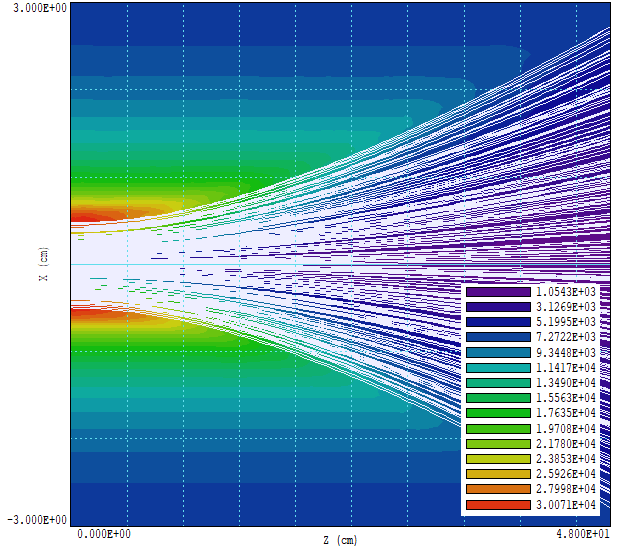
The GenDist input file TQSCharge.DST generates a parallel, uniform current-density proton beam of radius 0.5 cm with kinetic energy 50.0 keV and current 30.0 mA. The files TQFreeSpace.MIN and TQFreeSpace.HIN define a box of length 48.0 cm and width 8.0 cm with no applied electric field. The transverse walls are grounded. The OmniTrak run is controlled by the script TQSChargeFree.OIN. Because the only fields present are those generated by the beam, several cycles are needed to achieve consistency between the fields and particle trajectories. The second figure shows the beam profile and electric field created by the beam charge. The envelope radius expands to 2.8 cm, consistent with the theory covered in Sect. 5.4 of Charged Particle Beams. The beam has generalized perveance K = 1.738E-3 (Eq. 5.88). Taking χ/F(χ) = 1.06 (Table 5.1), the predicted envelope radius at 48 cm (Eq. 5.93) is 3.0 cm. The maximum beam-generated electric field magnitude is about 30.0 kV/m. For comparison, the applied quadrupole field at the entering beam envelope is 325.0 kV/m. Despite the order of magnitude difference, the effective forces are comparable because the beam field acts continuously while the quadrupole force is an average of focusing and defocusing components.
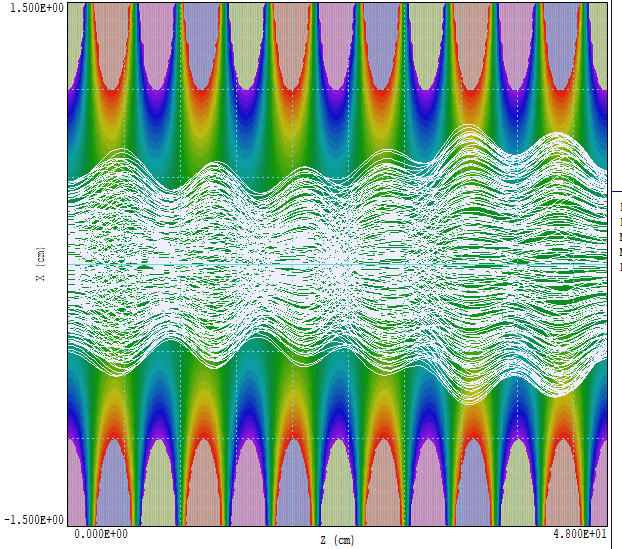
The main calculation combines the three-dimensional quadrupole electric field with the self-consistent beam-generated field (TQSCharge.DST, TwistedQuad.MIN, TwistedQuad.HIN and TQSCharge.OIN). The lower figure shows a plot of potential in the plane y = 0.0 cm with projected proton trajectories. (Note that the vertical scale is highly expanded.) There is a close balance between the defocusing beam force and the focusing quadrupole forces. The beam is confined well away from the electrodes so that 100% of the particles are transmitted.
|