|
Input files
|
TQFreeSpace.HIN, TQFreeSpace.MIN, TQFreeSpace.OIN, TQQuadField.OIN, TQuadEmittance.DST, TwistedQuad.HIN, TwistedQuad.MIN
Download TQEmittance.zip
|
|
Description
|
This example investigates proton beam propagation in the twisted quadrupole focusing channel shown in the top figure. The mesh and electrostatic solution (TwistedQuad.MIN, TwistedQuad.HIN) were created in a HiPhi example. The transverse solution boundaries are grounded and the upstream and downstream surfaces have the open-circuit condition. The assembly is positioned in z so that the electrodes are aligned with the x-y axes and initially defocusing in x. The choice was made to allow direct comparisons to results using field tables discussed in a following example.
The proton beam incident at z = 0.0 cm has radius 0.5 cm and kinetic energy 50.0 keV. A total of 2500 incident model particles are distributed uniformly over the cross section. This example treats a low-current beam with emittance. A following example addresses transport of a beam dominated by space-charge forces.
|
|
Results
|
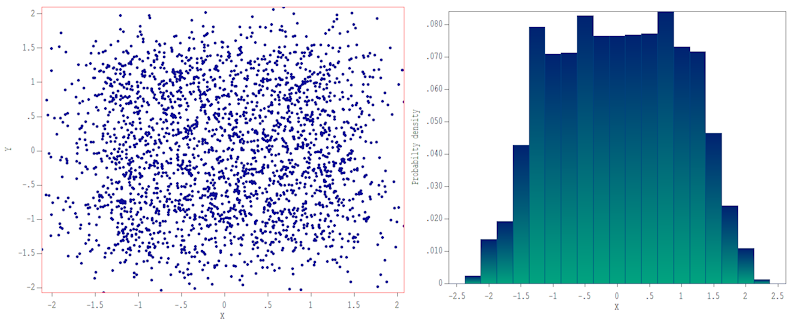
To represent the incident beam, the GenDist input file TQuadEmittance.DST creates the file TQuadEmittance.PRT with the following properties. Protons with kinetic energy 50.0 keV are distributed uniformly over a circle in x-y of radius 0.5 cm. The particles at all positions have random divergence angles in x and yuniformly distributed between ±2.0°. Such a beam drifting a distance 48.0 cm in free space should expand to a radius of about 1.7 cm with a tail extending to r = 2.2 cm. A calculation was made with electrodes removed from the solution voltage and no applied field (TQFreeSpace.MIN, TQFreeSpace.HIN and TQFreeSpace.OIN). The second figure shows a scatter plot of final positions at z = 48.0 cm and the corresponding distribution F(x).
The full calculation with quadrupole fields and termination of particles striking electrodes was controlled by the OmniTrak input file TQQuadField.OIN. Different multiplication factors on loading the normalized solution TwistedQuad.HOU were used in the EFIELD3D command to check focusing over a range of electrode voltages.
  ...
*  EFIELD3D: TwistedQuad.HOU 5000.0
*  EFIELD3D: TwistedQuad.HOU 5500.0
  EFIELD3D: TwistedQuad.HOU 6000.0
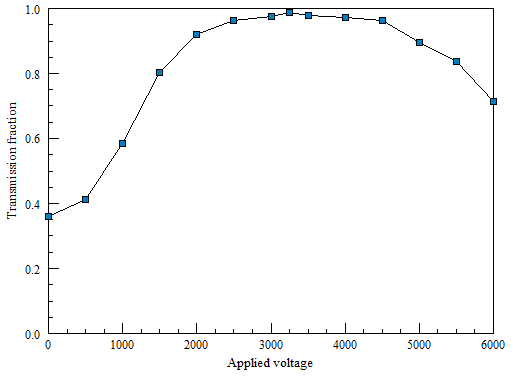
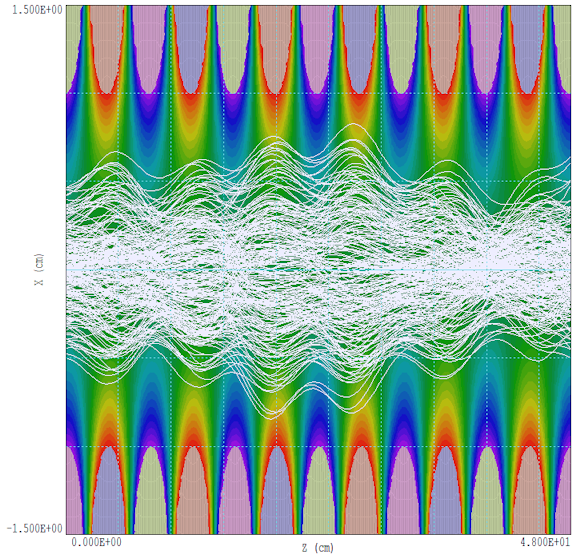
The third figure shows the transmission factor as a function of applied voltage. Low voltages were insufficient to counteract the beam expansion while strong defocusing forces at high voltages caused the beam envelope to strike the electrodes. At the value 3250 V, the transmission fraction was 98%. The final figure plots trajectories at this voltage projected in the x-z plane. Note that the vertical axis is highly expanded.
|