|
Input files
|
IndCircFull.CDF, IndCircFull.GIN, IndCircFull.MIN, IndCircGap.CDF, IndCircGap.GIN, IndCircGap.MIN, IndCircHalf.CDF, IndCircHalf.GIN, IndCircHalf.MIN, IndRectFull.CDF, IndRectFull.GIN, IndRectFull.MIN
ToroidalInductors.zip
|
|
Description
|
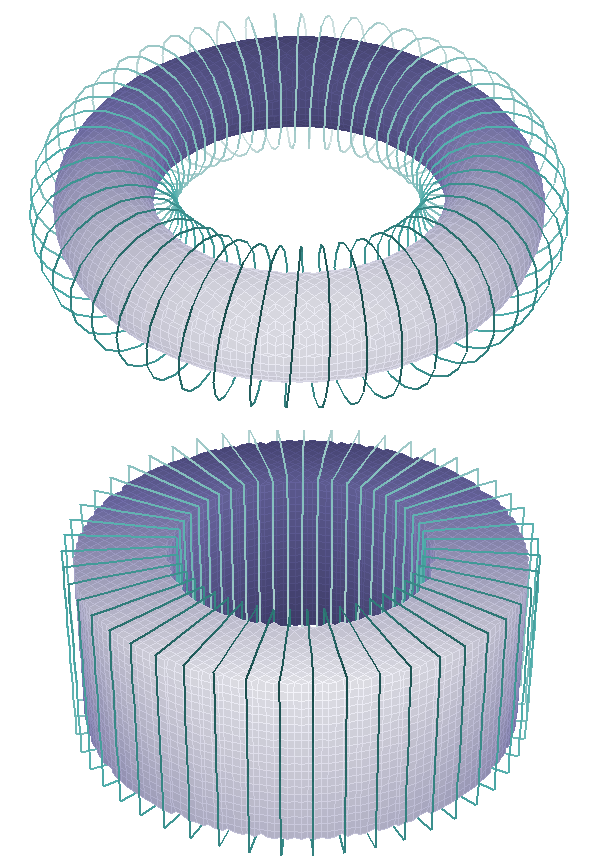
Three-dimensional models to find values for toroidal inductors. The examples illustrate MetaMesh techniques to model toridal ferrite cores with circular and rectangular cross sections, with and without an air gap. The models utilize the MetaMesh TORUS model and extrusions. They also feature the Magwinder TORUS and TORUSR models to generate windings encircling the full core or a portion of it. Input files for four models are included:
- IndCircFull. A ferrite core with a circular cross section, major radius R = 4.0 cm and minor radius r = 1.0 cm. The core is encircled by a toroidal winding consisting of 50 turns of radius 1.5 cm. Cores in all the models have MuR = 500.0. (Top of first figure).
- IndCircHalf. The same ferrite core as IndCircFull, but with a 50 turn winding the covers only half of the core.
- IndCircGap. The ferrite core of IndCircFull with an air gap of average width 1.0 cm. The winding covers an angle of 240 deg opposite the air gap.
- IndRectFull. A ferrite core with major radius 4.0 cm and a rectangular cross section (2.0 radial width, 4.0 cm height). The rectangular 50-turn winding is spaced 0.25 cm from the core surface (Bottom of first figure).
|
|
Results
|
IndCircFull
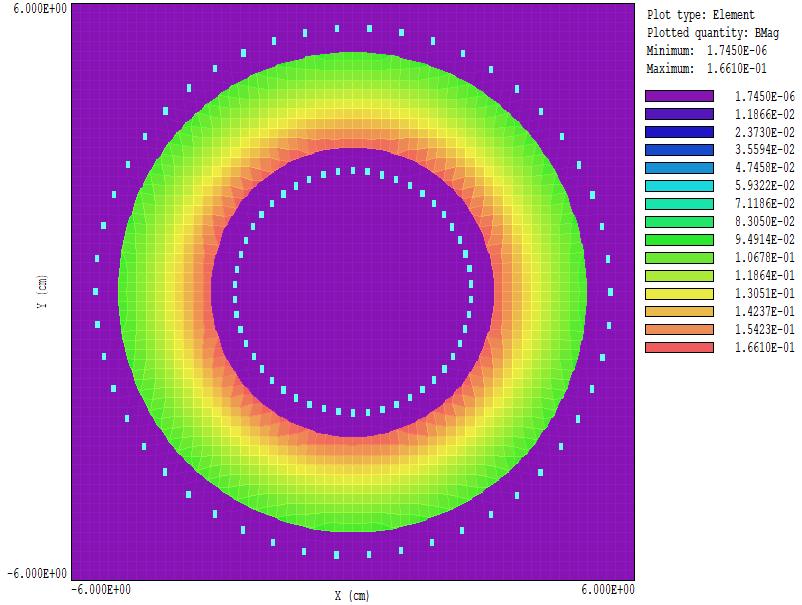
The second figure shows a slice plot create by MagView of the coil outline and field distribution in the plane z = 0.0 cm. The predicted value of BTheta at the inner radius (Ri = 0.03 m) is BTheta = Mu0*MuR*NI/2*pi*Ri = 0.1667 T. The code result shown in the second figure is 0.1661 T, within 0.4% of theory. The global volume integral function in MagView gives a total field energy U = 1.0122 mJ, of which 99.8% is in the core. For a 1.0 A drive current, the inductance is L = 2*U = 2.02 mH. Approximate formula for inductance, L = pi*Mur*Mu0*r^2*(NI)^2/2*pi*R gives 1.964 mH, close to the code result.
IndCircHalf
As expected, the inductance of a full toridal core assembly has little dependence on how much of the azimuth is covered by the coil. The inductance with a 50-turn coil that covers only 180 deg of azimuth is L = 2.065 mH.
IndCircGap
The third figure shows a toroidal inductor with an air gap. The figure shows the core and winding geometry above z = 0.0 cm and the variation of |B| in the plane z = 0.0. The small gap has a large effect, reducing the inductance by a factor of 3.16 to 0.640E-4 mH. The peak field magnitude in the plot is 6.5 mT. The gap contains a significant fraction of the field energy (38%).
IndRectFull
The code value for the larger core is 5.132 mH. We can calculate an exact prediction for the inductance by integrating dU = BTheta^2/2.0*MuR*Mu0 over the core volume, where the variation of field with radius is BTheta(r) = MuR*Mu0*NI/2*pi*r. The field energy is U = MuR*Mu0*(NI)^2*H*ln(Ro/Ri)/4*pi. Inserting parameters, the value is U = 2.555 mJ implying an inductance L = 5.110 mH. The agreement to within 0.43% confirms that the conformal mesh representation give high accuracy, even with a relatively coarse elements.
|
|
Comments
|
Two of the calculations (IndCircFull and IndRectFull) have symmetry and could have been addressed with a two-dimensional code. The other two calculations (IndCircHalf and IndCircGap) are fully three-dimensional. A typical run time for the Magnum solution was 24 seconds.
|