|
Package
|
Trak Charged Particle Toolkit
|
|
Input files
|
LCSphere.BAT, LCSphere.MIN, LCSphere.EIN, LCSphere.TIN, Output.txt
Download SphericalFlow.zip
|
|
Description
|
This benchmark illustrates the accuracy of the Trak and OmniTrak methods to model self-consistent space-charge-limited emission. The calculations represent converging flow between concentric spheres, where the outer sphere is an electron emitter. The numerical results are compared to the well-know Langmuir-Blodget analytic solution1. The example also demonstrates two code techniques:
- Analysis of the physics to determine general results from numerical calculations with specific parameters.
- Setting up automatic runs to generate a large number of data points
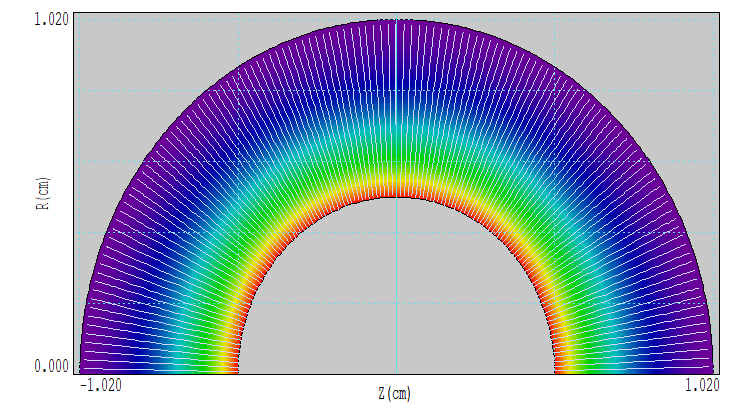
The upper figure shows the geometry. Electrons are emitted from the outer sphere of radius Rs and flow at the space-charge limit to the inner collector of radius Rc.The theory is reviewed in Sect. 6.3 of the text Charged Particle Beams. The current for non-relativistic particles is given by Eq. 1, where the parameter α2 is a function of (Rc/Rs).
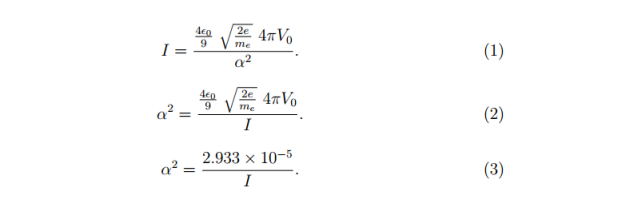 Solving for α2 gives Eq. 2. The implication is that we can choose any particle and applied voltage for a numerical calculation, and the calculated current yields the dimensionless parameter for a choice of Rc/Rs. For electrons, the relationship is given by Eq. 3 for the choice V0 = 1.0 V. The strategy is to choose source radius Rs = 1.0 cm and to carry out a series of calculations with different values of Rc to determine I.
1. I. Langmuir and K. Blodgett, Currents Limited by Space Charge between Concentric Spheres, Phys. Rev. 24, 49 (1924).
|
|
Results
|
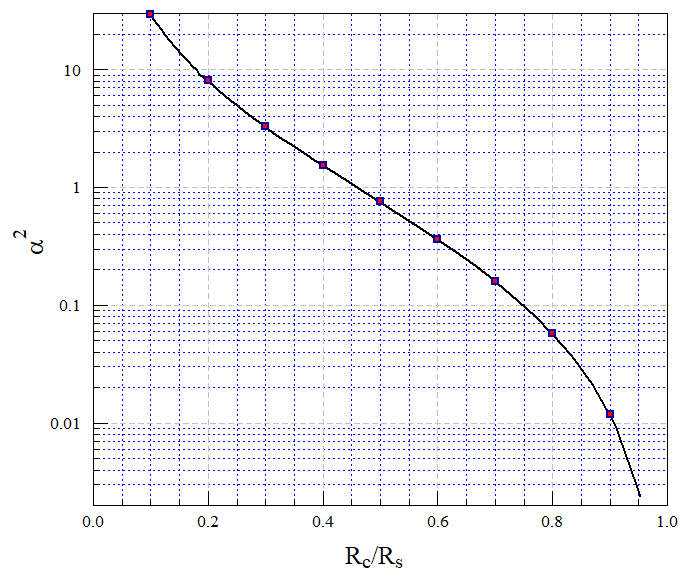
The upper figure shows the self-consistent potential and selected electron trajectories for Rc/Rs = 0.5. The element size is 0.01 cm with DEmit = 0.015 cm. The numerical result is α2 = 0.7501 compared to the theoretical value of 0.7500. The file LCSphere.BAT shows how to carry out a series of calculations for a range of Rc values:
IF EXIST Output.txt ERASE Output.txt

ECHO Rc/Rs: 0.90 >> Output.txt
START /B /WAIT C:\fieldp/tricomp/mesh.exe LCSphere -0.90 0.90
START /B /WAIT C:\fieldp/tricomp/estat.exe LCSphere.EIN
START /B /WAIT C:\fieldp/tricomp/trak.exe LCSphere
FINDSTR /L /C:"       16        " LCSphere.TLS >> Output.txt

ECHO Rc/Rs: 0.80 >> Output.txt
START /B /WAIT C:\fieldp/tricomp/mesh.exe LCSphere -0.80 0.80
START /B /WAIT C:\fieldp/tricomp/estat.exe LCSphere.EIN
START /B /WAIT C:\fieldp/tricomp/trak.exe LCSphere
FINDSTR /L /C:"       16        " LCSphere.TLS >> Output.txt

...
Note that there are separate pass parameters for the negative and positive values of Rc. An expression like "-%1" gives an undefined result. The final values of current are located in the Trak listing file and stored in the file Output.txt. The lower figure graphs the results. The solid line follows values in the Langmuir-Blodgett paper while the symbols show the Trak results.
|
|
Comments
|
The setup provides a good platform to check accuracy of the emission models as a function of mesh element size. Of course, the numerical approach extends far beyond this simple geometry (e.g., displaced spheres, ellipsoidal electrodes, cylindrical collectors and emitters,...).
|