|
Input files
|
EllipCond.CDF, EllipCond.GIN, EllipCond.MIN, EllipCond.SCR
EllipCond.zip
|
|
Description
|
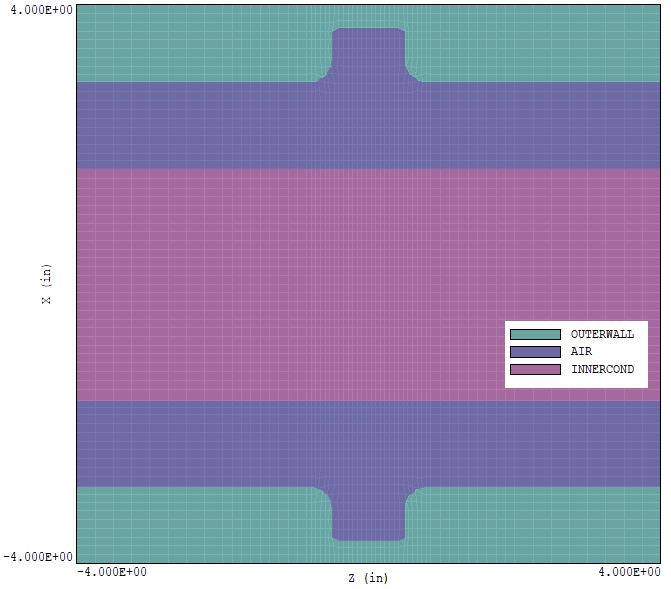
The example describes simulations of a test stand used in the development of a diagnostic for intense pulsed electron beams. The beam travels through a cylindrical conducting pipe. As shown in the upper figure, at an axial location the pipe wall is interrupted by an radial slot region that contains magnetic pickup loops at several azimuthal positions (dimensions are in inches.) The average loop signal gives the total beam current while differences between loop signals contain information to infer the beam shape and displacement. The test stand uses shaped metal center conductors to simulate elliptical beams. The average position of the center conductor can be displaced.
|
|
Results
|
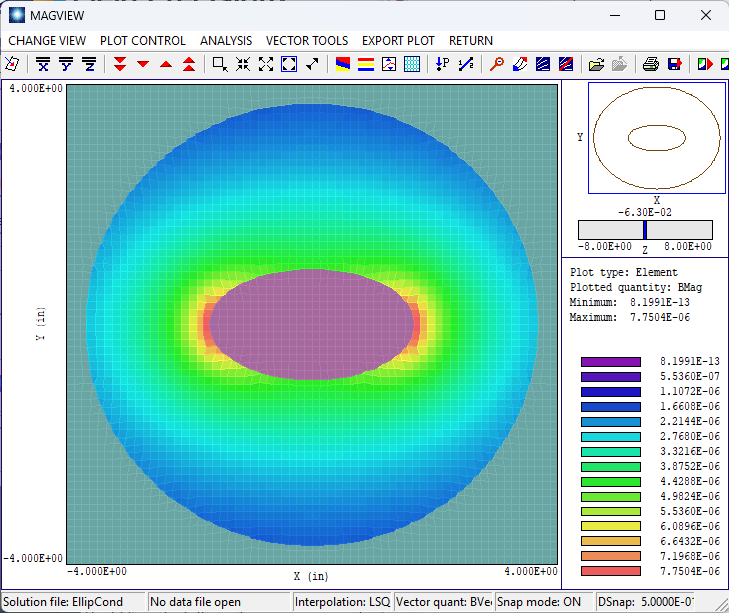
The lower figure shows the distribution of magnetic flux density in the transverse plane at the axial center of the slot for a highly elliptical center conductor. For reference, a circular center conductor carrying 1.0 A would generate a field of 2.645E-6 tesla at r = 3.0".
|
|
Comments
|
The example demonstrates a useful Magnum technique for dealing with pulsed currents and field excluders in the limit where the magnetic skin depth is small compared to the element size. The outer wall is simple field excluder. It is assigned a relative magnetic permeability much lower than unity. In this case, the magnetic flux density inside is very small and the external lines are parallel to the boundary. The challenge to assign drive current density on the boundary of the inner conductor. The non-uniform distribution depends on the shape and displacement of the conductor. The solution is to assign a small relative magnetic permeability to the conductor and to locate an axial drive current filament anywhere inside. The resulting solution has very small magnetic flux density inside the conductor with external lines of B parallel to the surface. The effective distribution of surface current density can then be derived from the change of B across the surface.
|