|
Package
|
Trak Charged Particle Toolkit
|
|
Input files
|
MacroTransport.MIN, MacroTransport.EIN, MacroTransport01.PRT, MacroTransport02.PRT, MacroTransport01.TIN, MacroTransport02.TIN, MacroTransport03.TIN
Download MacroTransport.zip
|
|
Description
|
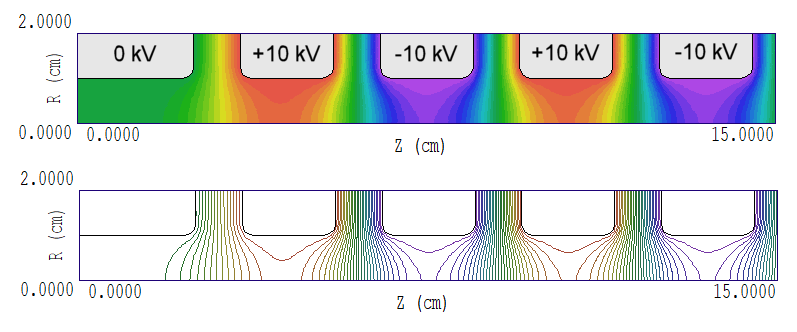
Although the Trak code is primary used to model beams of elementary particles like electrons and ions, the methods can be applied to particles of any mass and charge. This example illustrates electrostatic transport of macroparticles. We apply the term to particles that have much higher mass and charge than elementary particles, but are small enough to treat as point objects. The particles have the following parameters: mass M = 3.35E-11 kg, charge Q = 1.0E-12 C and velocity V = 40.0 m/s. A requirement is to transport a beam of the particles with diameter greater than 1.0 cm a distance 100 cm in high vacuum. The goal of the calculation is to determine the maximum particle flux F set by space-charge effects. The upper figure shows the entrance portion of the transport system, a set of cylindrical rings with alternating applied voltages.
|
|
Results
|
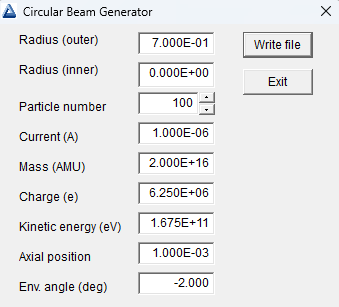
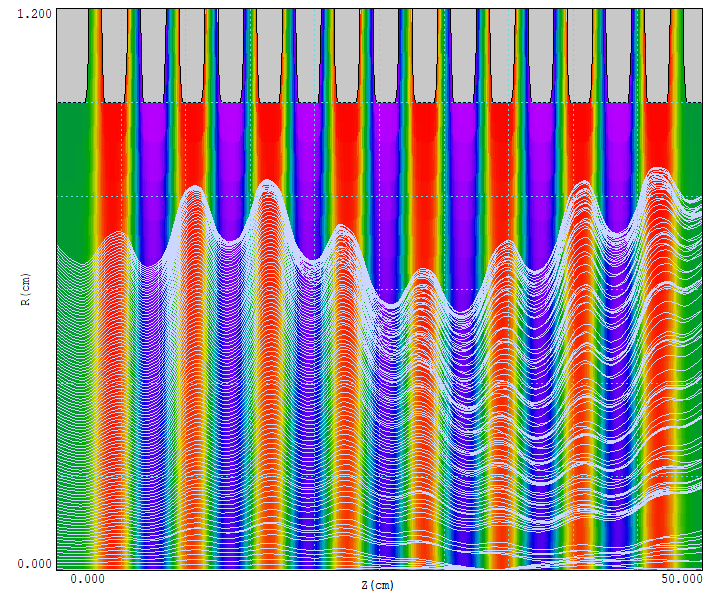
The input beam distribution was prepared using the Circular beam generator tool in Trak. The middle figure shows the dialog with parameters converted to the standard input units for an approximately matched beam. The lower figure shows model particle trajectories with an expanded radial scale. The three Trak input files address the following cases: 1) focusing forces with no space-charge effects to find the single-particle betatron wavelength, 2) matched focusing and space-charge forces (lower figure) and 3) space-charge forces only.
|
|
Comments
|
This tutorial gives a complete description of the theory and results: Modeling a macroparticle electrostatic transport system with Trak.
|